Showing posts with label travel. Show all posts

Saturday, January 24, 2009

Shinkansen, Hiroshima, Miyajima

First, a little translation.

Shinkansen = Bullet Train.

Hiroshima = "wide island" - or one of two cities that got A-Bombed in WWII.

Miyajima = Shrine Island.


My aunt and I started off the day on Saturday with an early rise to catch the Shinkansen to Hiroshima. They named the train very accurately - and as cliche as it sounds, we were flying along at mind-blowing speed with no sensory information other than sight to indicate how fast we were moving. A few times I tried to get a better look at things that caught my eye, only to see them zip out of view by the time I turned my head. I did manage to get some shots that gave me a sense of what Japan was like in terms of geography and urbanization.

Japan is much more flat than I had imagined. But, like Hong Kong, they still find it easier to build out into open water than up the side of a mountain. People here also like to live in standardized situations. There are no expensive "Ocean view condos" or Beverly Hills-style houses on the hill. People here seem to be somewhat reserved and shy - happy to live in a nice neighborhood like everyone else.


Unfortunately, given the absurd speed of the Shinkansen, I often ended up with photos of...wall...wall...blur...wall...blur...etc.


I never expected that Japan's rail system would be so complicated. The entire system seems to be comprised of a whole bunch of little private companies each with its own agenda, name, trains, and operating methods. I'm very glad I had a guide (Thanks a bundle Carolyn!) There is also no "whole system" fare solution as there is in Hong Kong with the Octopus Card. Japan is alone in my perception of the world in the sense that it is made up of cities with what seems like almost no space between. The railways all blend together in a way that I didn't expect and cannot compare with any other place in the world. The DC Metro is only meant for the DC Metropolitan Area, and the Hong Kong railway doesn't really connect to anything but longer distance trains that go to the border with China. Japan is really something different - as you can see below. Keep in mind that this is only a representation of Osaka, Kansai, Himeji, Kobe, and a few other towns/cities. This area is similar to the regions of Northern VA, Washington, Silver Spring, and Baltimore etc. in the sense of distances and urbanization. However, the blurring between city lines and time/distance ratios made this whole region seem much smaller.


I was able to catch a fairly nice example of graphic design, a-la DC metro Map. I mean that things are not drawn to scale or using the correct proportions, but the message is no less clear. The recognizable aspects of the trains, their "faces" as it were are each a little bit different, but different enough for Japanese to know the difference. Also, the train cars are not nearly as stumpy as they appear here, but the number of cars is much more important to travelers than their shape on a sign. It is also made clear which stairway to use to get oneself closest to the correct car on any specific train.
.


This is not a Shinkansen, but rather a more local train. Shinkansens operate like Amtrak in the US: only a few stops in each state - mostly for going really far without having to fly or drive. They stop at each major city, and cut travel times dramatically. The middle grade trains, like the one above are like Greyhound buses. They go from urban center to urban center, but you will probably need to figure out a way to get to the final destination yourself. This is where the local trains, light rails, and public buses come in. By using some combination of the three, one can get from within a few blocks of "Point A" to within a few blocks of "Point B".


The street cars are also really interesting here. You enter the vehicle for free and pay your fare when you "disembark" or as we Americans say "get off". Buses are the same way. I'm used to paying when boarding - entry fee style.


Upon arriving in Hiroshima, which would have likely blown away any preconceptions I had been foolish enough to hold , we hopped on a streetcar and made our way to the "A-Bomb Dome" one of the few buildings to survive the attack the marked the beginning of the end of the war with Japan. This was essentially a city center building that was used as an information center for businesses, an office for some of the city's services, and various other things over the years. Its dome was blown away in the blast, but its strong, solid walls and iron reinforcement for the dome were able to survive. Most experts attribute its survival to the fact that the blast's force was directed mostly downward and not across the structure.


Interestingly, this symbol of tragedy and devastation has had its image reinvented to that of a monument to peace. In this way, it has drawn in enough funds from wealthy donors to ensure that it will never fall down.


It's hard to believe that the A-Bomb Dome (left side of frame) is now among the shortest and smallest buildings in the city. People were rebuilding Hiroshima almost as soon as they stopped looking for wounded and dying.


Unfortunately, I visited the peace memorial park (below) before I entered the A-Bomb museum, so it didn't have quite the same impact that it should have had, but from an aesthetic standpoint, it is stunning. It is a very wide, flat, open, and uncluttered space - unheard of in most Japanese cities. The intense quiet that dominates this park is also surprisingly spooky.


Inside the museum were stories, photos, artifacts, and videos that really hit me hard. I thought I knew the story of the A-Bomb but it was much more deep, touching, and disturbing than I thought. I felt very lucky to even be walking around Hiroshima as an American, considering that there are still people walking the same streets having survived the bombing or lost loved ones to it.

In the foreground are a couple of lumps of coins that were fused together from the intense heat generated by the blast. The coins that have holes in the center make for a conveniently threaded bunch of money.


A couple of glass bottles that were melted into distorted silhouettes of their former selves by heat.


This next story speaks for itself. I am just a messenger. (click for a bigger image)


Below is a small-scale model of what was left of Hiroshima's buildings after the bomb detonated. The few that survived were built of concrete reinforced with iron. But that was probably not enough, since there were other similar buildings around that were obliterated. It is probably due in part to the fact that these buildings were beneath the epicenter of the explosion meaning that the blast energy compressed them, as opposed to shearing or shoving them off of their foundations. Japan's main method of construction then was wood and paper - essentially kindling. Even if the buildings were able to withstand the force of the bomb, they were burned like everything else all within one day of the bombing.

The dark spot in the center is a shadow cast by a ball hanging above that represents how big and high the fireball would have been just after it detonated.


After we finished our tour of the museum, we walked to this bridge, shaped like a "T" that the American bomber used as a target to drop the atomic bomb on Hiroshima. It detonated in the air only a few hundred meters to the southeast (I think).


After we wrapped up our tour of the A-Bomb Dome, The Museum and the park, we hopped a streetcar to the southwest side of the city to hop a ferry to Miyajima. After such a heavy-hitting morning, the general beauty and serenity of the island and the shrine were a welcome change.

At the end of the line we got out of the streetcar and looked around to find the ferry over to the island. It reminded me of Hong Kong and I realized how fortunate I was to be able to associate anything with the unique and incredible experiences I've had in Hong Kong.

The island has the kind of look of unspoiled beauty that I associate with things like "Jurassic Park, Lord of the Rings, Planet Earth and Braveheart" There was an air of beauty that transcended prettiness and nature. Maybe it was the fact that all of the vegetation was of a different variety than what I'm used to seeing in America and Hong Kong. The trees, grass, birds, and even the deer (below) are all just a little different, but enough to make me stand up and take notice.

On the ferry ride over, I caught a hint of English saying something about tame deer and taking care of passports and children so they are not harmed by the deer. It seemed like I was missing some information so I disregarded it but sure enough, there were cute little hungry deer wandering around the ferry terminal looking and sniffing for handouts. One even followed me for over a block before it came to the conclusion that I was not worth the trouble.


I thought that this was the perfect way to depict the modern impact on the old, classic beauty of the island. Even clouds look nice here, but ferries still do not.


The tide was about as low as it gets when we arrived at the island to walk through the shrine, which meant that the usual water lapping under the planks of the floor or rising up to meet the base of the torii, the thing above which looks like, and also literally means, a bird perch, were not present, but fortunately I was also able to get up close and see the bright colors and precise construction more clearly.


Pagodas come in all sorts of "flavors" around here. From basic old weathered wood to Day-Glo orange and white. I am sure that there is some reason for it, but I have yet to learn what that may be.

To the left of the neon orange pagoda is a shrine or temple (I do not yet know the difference) that is hundred of years old, if I remember correctly, and looks the part.


Sure the glass of the Bank of China Tower has a certain look, as does a sunset at the beach, but I personally feel that both pale in comparison to the way this majestic structure stands serenely on a hillside on a quiet island south of Hiroshima. It has withstood earthquakes, bombings, the A-Bomb, and probably countless other trials over its lifetime.

The wood looks very old in both its construction method and patina. I'd bet that all the nails used in this structure's completion would fit into one surprisingly small bucket. The Japanese are champions of precision engineering, and absurdly precise fitting in construction - both of which can eliminate the need for nails entirely.


The actual shrine is finished in the same colors as the neon pagoda, but there is enough raw wood to offset the intense orange a little and make it easier on the eyes.


The whole shrine is built on short stilts that allow it to stand a few inches above the surface of the water at high tide, creating what I imagine is a stunning reflection that dances with the colors and shapes of the shrine's columns, as well as the mountains surrounding the shrine grounds.


It is a non-issue for me to be unable to read the words, because I am sure that they are as impressive and beautiful as everything else that is associated with the shrine. The views, the sounds, the colors, the construction, and everything else that can't be put into words.


It is customary to wash one's hands and mouth with the pure water at the Shrine's entrance before entering so as to be pure before the spirit(s?). That's all well and good but the water was probably covered in a thin sheet of ice that morning considering the amount of snow on the roof of the shrine.


I think these shots clearly depict my early understanding of the Japanese people's attention to and appreciation of detail (as I spend more time here, I find myself noticing details in more and more situations). Not only are the all the faces of the tiles done in a beautiful finish and pattern, but the crispness and clarity of the pattern and details really impressed me. (The quality of these shots is pretty poor, so look for more to be posted in the near future)


We then hopped the ferry to the mainland under a beautiful late-day sun, we went home, and relaxed. I know that I was emotionally and physically drained after such a long and interesting day. I imagine that my aunt was as well.

Friday, January 23, 2009

Arrival, Airport, Impressions

Well, it's been another long while, and I've been completely out of touch, but I promise I'll share all the great stuff that I've done since arriving in Japan.

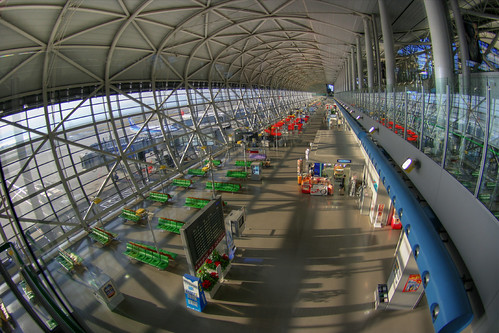
I arrived at the Osaka/Kansai International Airport on Friday afternoon. It is a beautiful airport that looks like an enormous section of silver or chrome pipe. While the description doesn't sound like much, a picture is worth a thousand words. The interior is also quite distinctive and absolutely beautiful.


Kansai Int'l Airport is, like some other airports in Asia and around the world, is built on "reclaimed land" or basically manmade islands out in the middle of the water. This is essentially due to the fact that water and mountains conspire against airports by niot allowing much flat land for runways or tarmac.

While approaching the airport, I noticed that Japan is composed almost entirely of small islands and mountainous "mainland". With so many islands, it is clear that there would be a lot of bridges.


Japan is also well known as the land of the small car. In America, most of the issues that people have with mercedez' SMART car revolve around not having enough space for people or gear. So what do the Japanese do? Slap a trailer on it! This way, the cabin can be used for carrying as many as 2...people. Only 2, but still, quite efficient with space, gas, and size.


I arrived in Kobe - after an hour of driving and staring at how industrial and busy everything seemed to be. Smokestacks, electric transformers and trucks were absolutely everywhere in Osaka.


I spent the afternoon and evening catching up with family and adjusting to Japan. Many people, myself included, often consider Asia to be one place, but after living in Hong Kong for five months, I can tell that there are very distinct differences between Japan and Hong Kong, as well as between Japanese and Chinese.

I put down my bags and noticed something in the corner of my room (my cousin has graciously evacuated so that I can have my own place).

What is that you ask? It's my bed! Well, it's the futon that I sleep on, and it unfolds to cover enough of the floor for me to sleep as well as I have in any hotel. I am not used to sleeping on the floor, but I must admit that it is quite comfortable, and by day, the bed can fold up increasing floor space dramatically - not possible with a framed bed.

Sunday, October 26, 2008

Associations, Patterns, and other interesting stuff.

Well, I promised a blog post that wasn't just another journal entry. So this is more of a mind dump with a theme. In my short(ish) time in Hong Kong, I've noticed that...well, I've noticed that I notice a lot. People who know me well, might say that I am an observant guy, and that I pick up on details, so Hong Kong has, at times, been a sensory overload. What with the noise, sights, smells, and the mix of languages I encounter daily, I have had to resort to a sort of filter. This means that when I get home, much of what I photographed throughout the day gets skimmed over or ignored. Well, here it is. A few of these photos have been posted, and some of them are nothing new, but I promise that if you look and read carefully, you will see what I saw that caused me to capture the shot. Hong Kong's Central District is packed with a lot of things, but I think the most dense resource therein would have to be interesting and alternative architecture. I have included the locations of most of the things I've seen, and Central is very well-represented.


While there are a lit of things in Hong Kong that are spectacular, interesting, or exciting in their own right, I find that the things I associate with them are often notable as well. Call me strange or crazy, but I'm pretty sore that most of these are not a real stretch by any means.

I don't purport to be the first to catch this similarity. In fact, I'm pretty sure that's what the architect had in mind. (Tsim Sha Tsui: Kowloon)

This, on the other hand, is likely not what the architect of the AIG tower meant for me to see. But I think AIG has other things on their minds at the moment. (Central: Bank District)


I'm not positive, but I think it's a safe bet that gold has a very similar connotation in this part of the world as it does at home. (Central: Bank District)(The building on the right and the reflection on the tower is Lippo Centre - which follows)
This pair of buildings, the Lippo Centre is as shiny, imposing, and mechanical as any "Transformer" could hope to be. (Central: Bank District)
The base of the Lippo Centre does a very good job of eliminating most of the visual mass of the higher floors, but I couldn't help but think it was a bit "industrial"(Lippo Centre: Central: Bank District)
I can't recall the name of this building, but it is a shape that, like IFC 2 and the Bank of China building (scroll down), says "Hong Kong!" loud and clear. It also looks like it's "perched" somewhat precariously. (Central-waterfront)


Bank of China Tower. This is another one that I think the architect would back me on. It's like a crystal/ice tower straight out of the comic books. (Central: Bank District)


The HSBC Building is polarizing in its aesthetic. While some people see it as "different" or a "breath of fresh air", others see it more as I do. Taking into account that it is adjacent to the Bank of China Tower (above) and its rooftop cranes are "aimed" directly at its neighbor and main competitor, it seems a little more sinister and aggressive. (Central: Bank District - across from BoC Tower)

I've forgotten its name, but, perhaps more importantly, I remember its appearance. And how could I not? Someone spent a gajillion dollars to make a distinctive piece of architecture that reminds one of...a cheese grater. The only other thing I could think of was a seriously huge game of "Connect Four", which is not much better. (Central)

I know I've heard the phrase Urban Jungle a few times. But it finally hit me when I conceived of this post, exactly how fitting that is. The buildings here are a lot like trees in a dense wood, with a few notable exceptions. Namely, they aren't so good for the environment, aren't too pretty, and more people can live in one of these than even the biggest of trees. The coolest part is that the grade of the hillside (and it is absurd at best) has little to no effect on either the trees or the apartments in Hong Kong. (The mountainside behind Central District)
On the mountainside behind Central are a great number of apartment complexes housing some of Hong Kong's elite. The organic architecture still reminds me of something more man-made. (behind Central)
Art Deco is alive and kicking on the mountainside behind Central District. (behind Central)
Think they mean it when they say "no climbing"? Pretty intimidating. (behind Central)
I was looking for a better image to fit this building but I seem to have forgotten a good deal of my Art History (sorry professors!). Anyhow, I'm sure you get the picture. This is the first evidence I've seen of an architectural style that seems much more common in western Europe. (Wan Chai)


These are actually two buildings that happen to be poorly positioned in relation to one another. They are municipal buildings related to performing arts and science, I believe...(Tsim Sha Tsui: Kowloon)


This is the Convention Center, which was the feature of a recent post. I was caught between wind, waves, and worms to relate to this building's form. Worms are just cooler than the other two. (Wan Chai)


Boutiques are known for being small, but then so are phone booths. I guess it depends on your point of reference. The Hong Kong boutiques can be closer to actual phone booths this little place on the Island. (Lan Kwai Fong: Central)


Probably not what Nike had in mind with this recent advertising campaign huh?

Hong Kong's tram operation allows advertisers to use every last inch of the tram's valuable surface for moving billboard advertising. It's not a bad idea, but I'm sure no one expected this either. (All over the Island)

While it is an intensely interesting effect that is produced by the front of the Joyce shop, I couldn't help referring to one of the least loved objects, ever. The sponge. To be fair, when it's viewed from a little further away, a giraffe-hide, butterfly wing, and leopard-print motif starts to emerge. (Central)

An Adidas, Olympics, Art, and who knows what else advertisement. (Lan Kwai Fong)

The Mira, which used to be The Hotel Miramar, has just completed a thorough rebirth. From a dowdy old gentlemen's hotel to a hip, modern, trendy spot. All of this is perfectly clear from the ripply, wavy new facade...Isn't it? (Nathan Road: Kowloon)


The Pacific Coffee Company did a great job with this wall of stylized coffee beans, but what were they thinking with that color? Really guys. Well done. (Wan Chai)

Harbour City is a mega mall among mega malls. It is at least four city blocks long and depending on the block, it is anywhere from 3 to 5 stories tall. It merges with numerous hotels, piers, and other oddities in its spread. It is indeed trendy, and I am sure that a number of other things will appear on my blog when I have the chance to really delve into what Harbour City has to offer. Further down is an example of Louis Vuitton's beautiful display works. By the way, it was from the roof of Harbour City that I watched the amazing fireworks display on National Day. (Tsim Sha Tsui: Kowloon)

Finally, we have the Harvey Nichols Store. Again, I'm sure the designer was going for some iteration of what I saw in this facade. It was late afternoon, so the contrast wasn't ideal for photography, but in the day when shade lends a helping hand, or at night, when the lights are played up a lot more, I'll bet this transforms into a real spectacle. (Central: very near the useless escalator referred to in a prior post)

There are also a few things that were either striking or simple enough in their own right, that I simply had to get a shot off.

It looks like a combination of Easter and LEGOs. And it does both a disservice. If you're going to mess with the colors, just go all out. The building in Wan Chai is a better example of "Distinctive", than this. Alas, this is right across the street from my apartment so I've grown used to seeing it daily. (Tai Po: New Territories)


I have yet to figure out what Mega Box is, but at least they have my attention. Day-Glo lives! (Somewhere between Tai Po and Tsim Sha Tsui)


Of course there was the obvious thought of a beehive, but this is distinctive enough to get its own mention. Again, probably would have made for a better photo at night, but I'm a busy guy. I got places to go, and blogs to post.

This is a great little building that has the unfortunate fate of being stuck down in a hole amongst vastly taller buildings, but it's classy enough to deserve notice. Oh, and that big, hollow block waaaay up at the top...That's a HUGE sign advertising Canon that spins slowly 24/7, ensuring that all of Hong Kong gets an eyeful of Canon.


It looks like a billboard. Well, a joke is probably more fitting, but I feel generous tonight so we'll go with garish billboard. But just out of frame is the front door to the "Billionaire Boys Club" which is an alternative clothing and accessories store conceived of and endorsed by Pharrell Williams(about whom I know nothing)


They're taking over the world! Really. They're common in America, but they are a way of life in Hong Kong. It seems like every item is offered in every size and every color. At least they had the presence of mind to organize them by retina burning color. (This is more evidence that Day-Glo did not die in the 80's) (Lan Kwai Fong: Central)


Accross the street from the Crocs store was a sign that said a lot with a little. I walked the other way.


In the Harbour City mall, there is a Louis Vuitton shop with a very interesting, even trippy feature(for all I know, there are a few more LV's in there - it's that big). There are two panes of glass, each with an applique of a mirrored checker pattern. Perspective, motion, focus, and reflectivity conspire to make passersby wig out and stop to catch their breath. It is an uncomfortable feeling, but then, it does get attention, doesn't it? (Harbour City: Tsim Sha Tsui)


Louis Vuitton has a way with window displays that put most others to shame. In this example(who knows how many LVs exist in Hong Kong?) They've hung chains of something shiny, presumably glass, that somehow move and twinkle like a myriad of stars, or flashbulbs, whatever your fantasy. Louis aims to please. (Central District)


Denim and accessories company, Diesel, has gone in a slightly different direction from most. The bottom pattern, which looks like a quilted surface or abstracted fish-scale motif, is actually - wait for it - chain link fence. And the bronze upper portion is a series of dimpled sheets. the pattern alternates between convex and concave leading to a pattern that reminds me of something slightly more upscale. Can you guess? (Central District)

That's right. It's the Coach store right down the street. It's funny to see how big some of these companies go with their logos. Actually, scary may be a better word. (Lan Kwai Fong: Central)
That about does it. Hope you all enjoyed this. I'm glad to have gotten some of the more obscure or singular photos out onto the interweb. Look forward to a report of my great weekend soon, in addition to a report on applying for and picking up my Hong Kong ID.
-Austin
-P.S.
Have you heard that space is quite limited in Hong Kong?